Christmas Anticipation

Christmas has always been my favorite time of year. I love everything about it: the music, the movies and TV specials, the lights, the decorations, the live Nativities, the shopping, the food, the parties, and the gathering of family and friends. But my favorite part of the Christmas season has always been the Christmas Eve candlelight service. There’s just something about candlelight. On Christmas Eve, the soft glow seems to fit the humble birth of our Savior.

As a kid, after the service, we sometimes took the long way home to look at the Christmas lights. Once we got home, we lit the last candle on the advent wreath that sat on top of our piano, sneaked a few cookies, then it was off to bed. I fell asleep in the golden glow from the electric candles burning in the windows and the mounting anticipation of Christmas morning.

Like most kids, my sister and I woke up early the next morning, but we weren’t allowed to go downstairs until our mom, grandmother, and great aunt were ready. We had to sit at the top of the stairs and wait and wait and wait. It killed us. They really knew how to build anticipation. I think they took longer than they needed just to torment us. And it did! “Please, hurry!” we begged. Knowing there were presents awaiting under the tree was almost more than we could bear!

When they finally had their hair combed and teeth brushed (and whatever else they felt was absolutely necessary to do before heading to the living room to open presents), we were told “Go ahead.” We barreled down the stairs, grabbing our stockings from where they hung, and plunged into them, eager to find the special surprises that were tucked inside. Christmas day had come!

I still love the feeling of anticipation at Christmas. I love seeing the anticipation on the faces of my grandchildren as we give out the presents and force them to wait to open them, taking turns and opening one gift at a time. I love having everybody gather together. And I still love the candlelight service.

This is, for sure, a season of anticipation. The advent season, in particular, with all the carols about Jesus’ birth, our savior coming as a baby. But I asked myself this year, am I anticipating Jesus’ return to earth with the same anticipation as Christmas? That day is also going to be a celebration with angels and trumpets and a gathering of God’s family. No soft candlelight—but the light of the world, the bright morning star, bursting onto the scene.

He won’t be coming as a baby this time, but as king—“Joy to the world, the Lord has come, let earth receive her king.” The advent of that day should also be a time of active preparation and joyful anticipation. We need to be ready to meet Jesus face to face. It’s like we’re sitting at the top of the stairs waiting with great anticipation and very soon, we’ll hear, “Go ahead, it’s time. Jesus has come!”

“So Christ, having been offered once to bear the sins of many, will appear a second time, not to deal with sin but to save those who are eagerly waiting for him.”  Hebrews 9:28 ESV

Dad’s Diploma–80 years in the making

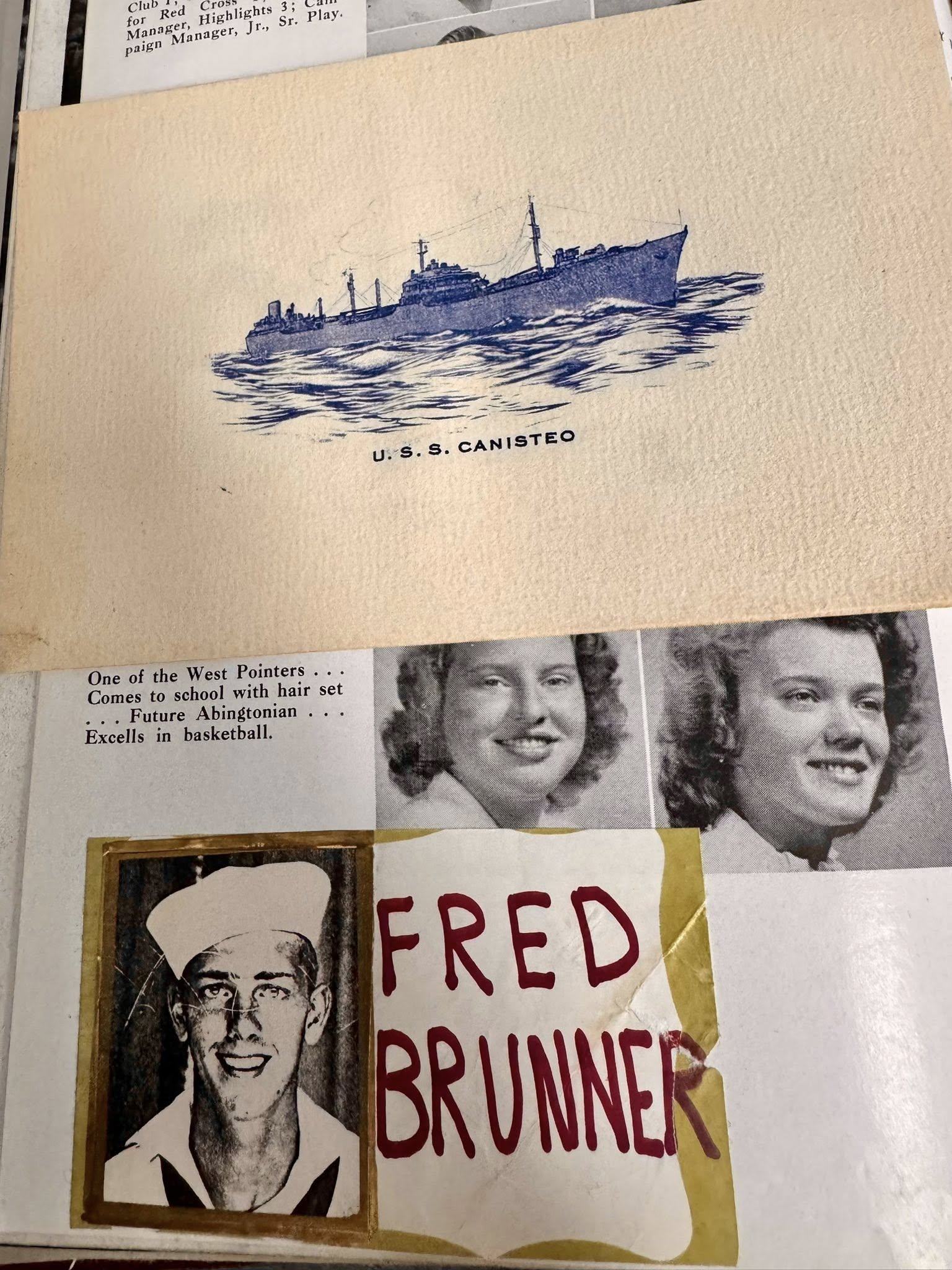
In the spring of 1945, high school seniors were being drafted into the Army. My dad was a senior that year and was willing to join the war effort but not willing to join the Army. So, he dropped out of high school and enlisted in the Navy on May 23, 1945.

I have a shoebox full of letters between him and my grandmother from bootcamp to discharge, all in perfect cursive and complete sentences—it’s hard to believe he was just a seventeen-year-old boy. One of her letters described the Vesper Service on June 3, 1945. She wrote, “You know I felt very bad that you couldn’t be with your own original class to graduate. That’s a big disappointment. I am sending you the program. The choir did not sing a bit good. You know why, because you weren’t in it. The sermon was terrible. It did not even seem like a sermon. You know why everything was so bad because you weren’t in the class. See you really rate, you dear thing.” He really did have an excellent voice with perfect pitch.

His time in the Navy took him all over the world. He described Aruba as a hot wasteland no one would ever want to visit! I guess there was no tourist industry on that island in the 1940s. He was in awe of a newly commissioned aircraft carrier that his ship was docked next to in the Caribbean. It was the USS Midway. He went to Europe and the South Seas before being discharged in June 1946. The war was over. It was time to send the boys home.

By this time, his father had died, and his mother had to go to work. She wasn’t able to keep their beautiful home, described as the most beautiful home in town back then. When Dad arrived at home, he needed a job but didn’t have a high school diploma. He earned his GED and went to work for the US Post Office, but it always bothered him that he wasn’t awarded a diploma because he left school two weeks before graduation.

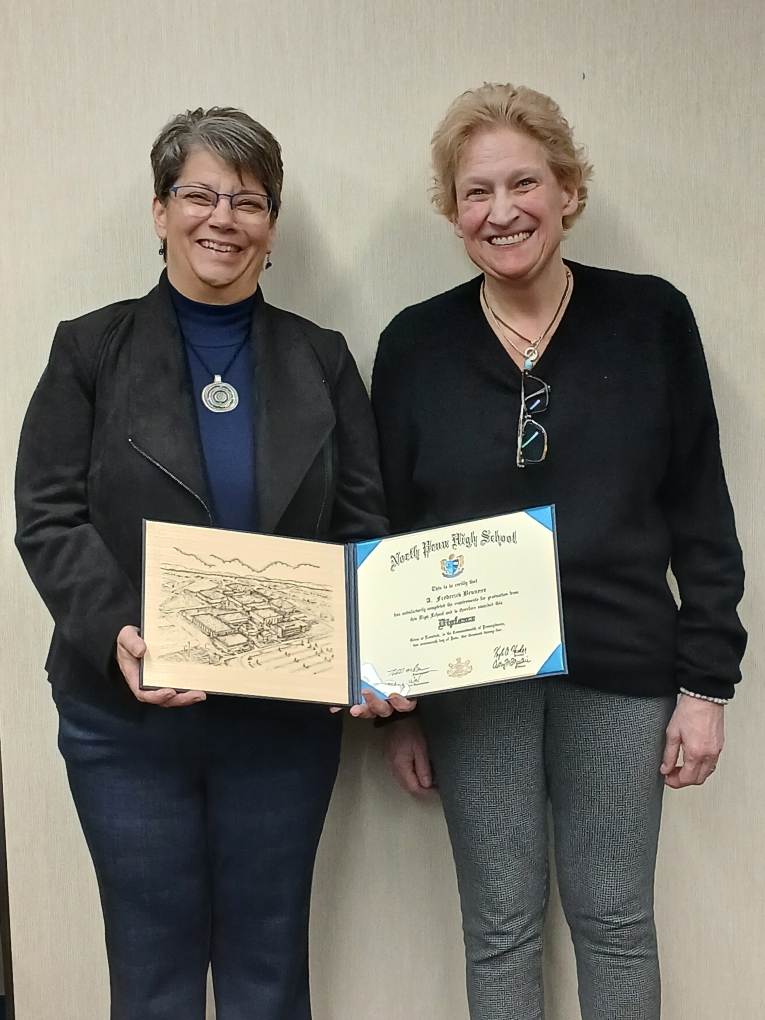
As part of a Veteran’s Day celebration, North Penn School District awarded my dad (and four other veterans) their diplomas last night. It comes eighty years later than it should have and twenty-seven years after his death. But he would be grateful—that’s just how he was. Gentle, kind, patient, a Navy veteran, and now a high school graduate.

Camp Good Enough

Mismatched silverware, pots with lids that teeter, used furniture in need of some reinforcement—these are the kinds of things you’ll find in our little cabin in Maine. The natives call it a camp, not to be confused with a cottage. A camp is more rustic (think outhouse).

The yard sale finds are described as “good enough for camp.” The maintenance and projects done achieve that same level of quality: good enough for camp.  Doors aren’t quite level—it’s good enough for camp. Your painting project dripped here and there—it’s good enough for camp. Using clothespins to hold things together—good enough for camp. You get the idea. MacGyver would love it here. Camp is not perfect. That’s where it gets its charm. Along with sitting at the edge of a pristine lake with the most spectacular sunsets you’ll ever see.

Camp is not my home. It’s where I go on vacation, disconnect from the world, slow down, and just relax. There are things I do here that I can’t do other places. Unfortunately, there are things I used to do here that I can’t do anymore. I can still kayak, but getting out of the kayak is all the cardio I need for the day (and maybe some prizewinning video for AFV). But the things that make camp special: admiring sunsets, stargazing, reading just for pleasure, listening to the soulful cry of the loons, and making memories with family and friends are still in my wheelhouse.

Of course, I have dreams of making it a little less rustic, at least attaining the dream of indoor plumbing. But for now, it’s good enough for camp.

What’s “good enough for camp” is not good enough for my permanent residence. Repairs need to be done correctly. Painting and other maintenance require precision. Furniture is purchased after much research, procuring just the right item for the space. A certain level of quality is expected. Even the silverware matches.

But that home isn’t my permanent home either. It’s very nice and well-equipped. It’s full of beautiful things with special meaning. Some are valuable, some are invaluable—like handmade cards and pictures from my grands. But even with all of those, it won’t come close to the beauty of my permanent home. That beauty won’t be the architecture or the sunsets or the furnishings. The beauty and joy of my permanent home will come from being in the presence of Jesus, my Savior.

I will do things there that I can’t do here, like worship God perfectly in spirit and in truth. It’s where I will enter into perfect rest. I won’t have to battle sin anymore, and I won’t shed any tears. No more sorrow or shame or anger or regrets or physical limitations. I don’t care what my permanent home looks like, although I think since Jesus knows me better than I know myself, it will be the dream home I couldn’t dream up on my own.

I don’t know what it is he’s working on, but he said he’s preparing a place for me. Considering he simply spoke the world into existence in a matter of days, I can’t imagine what he’s preparing. I have a feeling there’s a lot more to it than matching silverware and hopefully no need for indoor plumbing. What do you think he’s preparing?

I am writing this blog from camp. You won’t see it for a few weeks because we don’t have internet here. I’m looking out the window at a patio set that has seen better days. I was thinking we should replace it, but you know what? It’s good enough for camp.

In my Father’s house are many rooms. If it were not so, would I have told you that I go to prepare a place for you? And if I go and prepare a place for you, I will come again and take you to myself, that where I am you may also be. John 14:2-3 ESV

Lessons from a Fire: Lesson 3 – Grieving What Was Lost

My last two blog posts shared connections I saw between a fire at a local bank and recovering from sexual abuse. The first showed how setting up boundaries is essential to rebuilding in safety. The second explored the dangers hiding within the walls. Today I’m going to move from the bank fire to something a little more personal—a fire at our home.

We were jolted awake by pounding on our front door. Jumping out of bed and running down the hallway, my husband yelled over his shoulder, “Call 911—the garage is on fire!” From our bedroom, I saw an orange glow filling the window at the end of the hallway, a stark contrast to the night sky. I stumbled to the phone, but just as I got there, Doug hollered up the stairs, “Never mind. They’re here.”

It was a police officer who had been pounding on the door. The newspaper delivery boy (remember those?) saw the fire and called 911. I was thankful for the young entrepreneur making his rounds, tossing newspapers on porches before sunrise. Fire trucks rolled up and started dousing the flames. The backyard filled with first responders, onlookers, and possibly the arsonist. We found out from the police that it was arson season. At the change of seasons, the arsonists come out. And they like to hang out and watch the devastation. I never knew.

Fortunately, our garage was at the back of the property, safely away from house. It was actually three structures meshed together over 100 years. The oldest was a chicken coop, then a storage shed, and finally a garage. We used the entire structure for storage. It was full: projects we were working on, kids’ outdoor toys, tools—you name it, it was stored there.

And that was the problem. So much stuff. By the time the fire was completely out, the garage and its contents had been reduced to ash, mangled metal, and unidentifiable melted stuff. The insurance company was happy to reimburse us for the value of everything we lost. All we had to do was figure out what was lost and the replacement cost for it—before googling was a thing.

First, we had to remember or identify all that was lost. Sifting through the remains, some items were obvious and some were not. A melted red and yellow lump stumped us for a short time. Then we remembered: the Little Tikes car. There were antique tools that just needed to be cleaned up. But other antiques, including a set of French doors we were refinishing, were destroyed.

The research began. We lived in an area saturated with antique stores. I visited several of them, asking about the value of the things we had lost. Then I browsed the local Sears Hardware store to price all the tools, ladders, gardening supplies, and other items we could remember were inside the garage. The insurance company would only pay one time, so anything we had forgotten to claim could not be claimed later. As the years went by, and we needed a particular item but couldn’t find it, we realized it was probably in the garage.

The connection to rebuilding after sexual abuse is that it is necessary to recognize what was lost. We may even have to make a list. That list might include childhood innocence, trust, safety, relationships, self-worth, and more. Grieving the things that were lost is necessary. But we don’t want to stay in the ashes. After acknowledging what was lost, it’s time to rebuild.

Over time, flashbacks or memories of abuse may surface. I still get those, 45 years after my abuse ended. I believe God brings to mind past abuses when we are ready to work through them. Unlike the insurance company’s one-time payout, we can continue to work through the memories and effects of abuse for as long as it takes.

For our garage, my husband designed the new garage and did most of the rebuilding himself, with some help from friends. The police never found the arsonist, so justice was never served in that way. Likewise, most abusers are never charged with a crime or brought to justice, but that doesn’t mean we are stuck with a pile of ashes. After the fire, we removed the ashes and rebuilt something better than the hodgepodge of structures that was there before.

Survivors of abuse can do the same with the help of friends, support groups, counselors, and God himself. He is the master designer and builder. The life he can rebuild from the ashes of abuse may be more beautiful than if the abuse hadn’t happened. But it takes work. Set up boundaries to rebuild from a place of safety. Recognize the harmful effects of abuse. Grieve what was lost. And trust God to create beauty from ashes.

And provide for those who grieve in Zion—to bestow on them a crown of beauty instead of ashes, the oil of joy instead of mourning, and a garment of praise instead of spirit of despair. They will be called oaks of righteousness, a planting of the Lord for the display of his splendor. Isaiah 61:3 NIV

If I can help in your rebuilding, please contact me.

Lessons from a Fire: Lesson 2 – Danger from Within

Lessons from a Fire: Lesson 2 – Danger from Within

Two weeks ago, I shared parallels between a fire destroying a local bank and sexual abuse. The first lesson was about setting up boundaries to start rebuilding from a place of safety. You can read that blog here. The parallels didn’t stop with the boundaries. Today’s lesson is on the danger that no one could see.

The day of the fire, customers and employees came and went without a clue that there was something dangerous going on within the walls of the bank. It wasn’t someone planning a heist or a disgruntled employee about to explode. It was an electrical short, literally within the walls.

This branch looked no different than any other. Everything seemed completely normal, with no cause for alarm. But just hours later, the wailing of alarms pierced the air. Three fire companies raced to the scene. Witnesses described flickering hues of bright orange as flames engulfed the lobby. Thick black smoke billowed skyward. Vinyl siding dripped on the outside, insulation sparked inside, baskets of promotional pens melted into white mounds.

Once the fire was doused, the extent of the damage could be assessed. The building was a total loss. It would have to be torn down and rebuilt. The investigation found that faulty wiring caused the fire. It was an electrical problem that had been festering probably from the time the bank was built several years earlier. It finally got to a point that a spark triggered a fire within the walls, destroying the entire building.

Again, I thought of the devastation of sexual abuse. Abuse victims are among us everywhere we go, yet we can’t tell they are survivors of something so devastating. They look like everybody else in our circle. They smile, they raise their kids, they go to work, they attend church, they cheer for their home teams, they go to the beach for vacation. They seem just like you. Maybe they are you.

But maybe something has been smoldering inside them, unknown to anyone else. That was me. No one knew I had suffered sexual abuse until my abuser was arrested a decade later. People thought I was just a quiet, introverted child. Really, though, fear and shame paralyzed me.

 Survivors can live a lifetime with something smoldering under the surface. Every now and then, they squelch a small fire, and no one ever knows about it. Other survivors barely make it through the day without a complete meltdown. They succumb to triggers that send them into a tailspin of disaster. They try to hide the damage, but eventually that short circuit will shake them to their foundations.

Like the bank, they may need to tear things down to safely rebuild what was lost. There’s a process of removing the damage left by shame, fear, anger, mistrust, and hopelessness. It starts with talking about what happened with someone safe. It takes time to process what happened and how it affected them. But with a strong foundation of safety and support, they can rebuild with confidence.

There’s no point in pretending the abuse didn’t happen or didn’t cause any damage. Imagine if the bank had done that—just continued business as usual, ignoring the damage the fire caused. They probably wouldn’t have stayed in business very long. A support group is a great place to start repairing the damage. Survivors can share their deepest struggles with others who can empathize with them and begin peeling away the layers of damage.

The bank hired a professional to rebuild their building. They had the blueprints and ability to remake the bank building exactly as it was before. Survivors are in even better hands because God is in the business of healing and restoration. Even if there is no support group or counselor around you, God is always with you. You can trust him with all the damage abuse caused. He already knows what’s been going on inside of you that no one else can see. He knows what triggers you, and he knows the plans he has for you. He won’t leave you living in brokenness. He has a plan to build your life into something strong and beautiful.

I will restore to you the years the swarming locust has eaten (or the fire has burned or the abuse has stolen). This promise of God in Joel 2:25 was my foundation as I began the healing process. And God has been faithful to his promises. He walked with me through the fire of abuse. He took away my shame and fear and replaced them with hope. He made me stronger, more compassionate, and more resilient than I would have been without the abuse and the work it took to overcome it. He more than restored the years lost to abuse. And he will do that for all who put their trust in him.

Look for (at least) one more lesson from the fire in another week or two.

Lessons from a Fire – Lesson 1: Safety First!

A fire tore through a local bank building just over a year ago. The lobby was destroyed. Remnants of black smoke clung to the stone facade above the boarded-up doors and windows. Clearly, there was structural damage to the drive-thru, and large pieces of fascia curled away from the building like peeling paint. Over the next few weeks, a salvage company demolished the rest of the building and leveled the ground around it. The burned-out business put up signs saying they were rebuilding. Several months passed with no evidence of rebuilding. But then a construction company’s billboard-sized sign appeared, announcing the rebuilding project was underway.

This time, evidence of rebuilding appeared. Heavy equipment was parked on the property. Dirt was pushed around. But what stood out to me was that barricades were set up. One of the first steps in rebuilding was making the project safe. A big part of that safety plan was to keep out those who might cause more harm.

As an abuse survivor, those barricades were a visual reminder of the need to set up boundaries while in the process of rebuilding what was lost. Many survivors have false guilt when they create space between themselves and those who might cause them harm. They know that some of those people don’t mean to cause harm, but their words or attitudes do just that. So, to rebuild their emotional health, they may need to erect some barricades and keep certain people out of their lives, at least for a time.

The barricades on the bank building remained until the construction was just about completed. They were in place until all the structural work was done, and just the finish work on the inside was left. But it occurred to me that the inside still has a barricade in the form of a vault. Very few people who enter the bank will be allowed access to the vault. It’s not for everyone, just those with the right clearances. Survivors should make note of that too. There will always be parts of their life or story that are not for everyone, just the most trusted people in their lives. And that’s okay. It’s not just okay, it’s necessary.

Most abusers are people who were trusted. Being harmed by someone you trusted is as damaging to a person as that fire was to the bank. Like the rebuilding of the bank, survivors need to do the work of removing the damaged areas and preparing their hearts to rebuild trust. Rebuilding trust takes time.

Start with the barricades. They allow you to rebuild from a place of safety. The first steps might be with a counselor, pastor, or trusted friend. It might be in a support group. It needs to be with people who won’t do more harm. Over time, you will rebuild trust and be able to take down some of the barricades because you’ll feel safe without them. In the process of rebuilding, you’ll become more resilient. Even if someone harmful shows up in your life, it doesn’t mean that what you’ve rebuilt will come crashing down. You will have learned that other people don’t control you or your emotions—a big step in the rebuilding process.

Eventually, you’ll feel that the barricades can come down, except that vault. The keys to that are only for certain individuals and God himself. He is the one who can be fully trusted with your heart and life. We will never fully understand the depth of his love and care for us. He promises he will fight for us, he will restore us, and he will bring us safely home. Even when we don’t feel safe or wonder if all that was lost to abuse can be restored, God will fulfill his promises, and we can rest safely in that.

After you have suffered a little while, the God of all grace, who has called you to his eternal glory in Christ, will himself restore, confirm, strengthen, and establish you. 1 Peter 5:10 ESV.

Scar Season

It’s the season of scars. The kids are outside again. Skinned knees are just a stone-under-a scooter-tire away from happening. Time to stock up on the Paw Patrol Band-Aids® and fill the freezer with boo-boo bunny ice packs. The adults are not immune to the scars of spring either. My husband has already started a few new ones from cutting down some trees, pulling out picker bushes (his nemesis), and getting the zero-turn ready for the season.

My scars are well documented in my second book, A Time to Laugh: My Life Over Fifty with talk of tattooing them into something fun (check it out). But just for good measure, I tripped over one of the picker bush vines while walking in the woods yesterday and did a full body plant. I told Doug where it is so he can eradicate it from the face of the earth. Fortunately, I didn’t break a hip, but I may have a new scar somewhere. Oh well. Tis the season.

The most important and most talked about scars of this season are the ones Jesus acquired when he went to the cross. And they should be. His scars were from wounds that bring us healing. Think about how he got those scars: from the crown of thorns pressed into his head; from the scourging (short whips with sharp pieces of bone and metal) of his back, buttocks, and legs; from the nails in his feet and hands; and from the spear that pierced his side. They ought to be talked about and pondered this Easter season.

In the past year, I had torn rotator cuffs (yes, cuffs, both of them). Because of my FQAD, torn tendons are common. I’ve had a torn rotator cuff repaired in the past. But this time, as I remembered the pain and difficulty recovering from that surgery, I hesitated to do it again. I didn’t have FQAD then. It can be negatively affected by anesthesia. It could cause more tears after the repair. I was torn about what to do with these tears. So I spoke to my physical therapist.

He said that if I decided not to have surgery, PT would help build the muscles around it, and scar tissue could develop, which would maybe do some “repairing” of the tear. I opted not to have surgery. I’m so glad I made that decision. I have almost full use of my shoulders. It seems scar tissue did form over the tears. So, the scars had some healing properties, but they can’t do what Jesus’s scars did.

His scars healed the broken relationship between the Father and his children. His scars brought eternal healing, full and forever. My scars bought me a little time to be able to do things with less pain. His scars healed me for all of eternity. My scars only affected me. His scars were effective for the whole world.

He was pierced for our transgressions; he was crushed for our iniquities; upon him was the chastisement that brought us peace; and with his wounds we are healed. Isaiah 53:5 ESV.

Daffodil Hope

Early spring in my neck of the woods is one of my favorite seasons. Down by the lake behind our house, the peepers hatched, and they fill the air with unending chirps. The red-wing blackbirds are back, squawking loudly. Their songs are challenged by the grackles’ return and their calls that are reminiscent of an old rusty swing.

There’s a red hue on the tips of the tree branches, promising the gray winter woods will soon be replaced with the pale green of new leaves. Slivers of bright yellow are peeking through buds on forsythia bushes, ready to burst. A few pink cherry blossoms have already popped open. All of these are signs that spring is indeed here.

My favorite sign though is the daffodils blooming in the woods. I think it’s because they sprout and bloom among the dead leaves on the forest floor. New life rising from where there was only death. I can walk through the woods, with the dead leaves and fallen branches crunching under my feet and come upon a delicate daffodil with its colorful little trumpet reaching for the light. They brighten my mood, making me smile. They give me hope that more flowers and warmer temperatures are on the way. And they are a perfect picture of new life in Jesus. We were dead in our sins, but God made us alive in Jesus.

Maybe it’s not a perfect picture of new life in Jesus because the daffodils always had some life in them, even as dormant bulbs. They just needed the right conditions to sprout and come to life. We are kind of the opposite really. We are alive: eating, breathing, heart beating. But spiritually, we aren’t dormant, we’re dead. Warm temperatures, a change in seasons, the right amount of rain and sun—none of it will bring us to life. It took another death, the death and resurrection of God’s own Son, for us to have a chance at new life, eternal life.

New life can come at any time of year for those pursuing it, not just springtime. It doesn’t have to wait for the seasons to change. It just takes recognition that you’re dead in your sins and a desire to be alive. Believing that Jesus died in your place so that you can have eternal life is the beginning of faith. Faith blooms and flourishes as it pushes through the dead stuff of our lives, leaving it all behind, and reaches for the light of the world. These are the thoughts I have when I see the first flowers of spring among the deadness of winter’s remnants. And my heart is forever grateful for the new life I was given forty-five years ago.

Why stay dead when Jesus offers you eternal life? Spring is a perfect time for a new life—a season of new beginnings, of hope, when the dead are raised to life, like my little woodland daffodils.

But because of his great love for us, God, who is rich in mercy, made us alive with Christ even when we were dead in transgressions—it is by grace you have been saved. Ephesians 2:4-5 NIV

That Other Christmas Trip

As I’m putting away the Christmas decorations, I’m thinking about the way the first Christmas ended. Not with storing the stockings and jingle bells for next year, but with a trip to the temple in Jerusalem.

I hadn’t really thought about the fact that Mary, Joseph, and Jesus took a trip to Jerusalem about seven days after his birth, but it’s recorded in Luke 2:22, 24:

“And when the time came for their purification according to the Law of Moses, they brought him up to Jerusalem to present him to the Lord and to offer a sacrifice according to what is said in the Law of the Lord, ‘a pair of turtledoves, or two young pigeons.’”

We hear about Mary and Joseph’s trek to Bethlehem and lament with Mary about walking or riding on a donkey over hill and dale while carrying a full-term baby. But their next trip could not have been much easier. In fact, I would prefer to travel while pregnant over traveling with a newborn, even the short distance from Bethlehem to Jerusalem.

Traveling while pregnant is uncomfortable, but traveling with a newborn is a whole different ballgame. You don’t just grab your purse, phone, and keys and jump in the car. You pack a diaper bag, throw in the stroller and port-a-crib, make sure the car seat is appropriately secured, and don’t forget the extra clothes and clean-up supplies for when the baby spits up all over you. Ugh.

Okay, maybe Mary and Joseph didn’t pack a lot of extras, but they did make a trip to Jerusalem with a newborn. I think she took that trip with Jesus clutched to her chest, if she was as nervous as I was bringing my first baby home from the hospital. How many times did she tell Joseph to be careful or to slow down guiding the donkey?

 As I took a closer look at that trip, the reason for it struck me: it was for their purification. The birth of Jesus made Mary unclean. His conception was miraculous, but his birth was typical, albeit in a stable and announced by angels. A typical birth included bleeding. Bleeding required purification. The Law of Moses in Leviticus 12 says that “if a woman conceives and bears a male child, she shall be unclean for seven days.” Verse 4 is what really made me think. “Then she shall continue for thirty-three days in the blood of her purifying. She shall not touch anything holy, nor come into the sanctuary, until the days of her purifying are completed.”

I pictured Mary, unable to enter the sanctuary or touch anything holy, holding Jesus—the holiest of holies. How ironic! She was there to offer sacrifices (two turtledoves) for her purification. For the following thirty-three days, Mary wasn’t to touch anything holy. During that time, she would have held baby Jesus, nursed him, changed him, bathed him, burped him, patted him, and rocked him to sleep (or bounced him on her knees to sleep, if he was anything like my babies). She was a mom with an extraordinary yet typical baby who needed her touch in many ways.

She lovingly handled that holy baby, as the days of her purifying were completed and beyond. How many times did she pick him up to comfort him or cuddle him? She was kept away from the sanctuary, but not from the one who made it holy.

One day, her baby would shed his own blood, the holiness of which would fully cleanse her from her sin. There would be no more need for sacrifices of turtledoves or days of purification or trips to faraway places dragging along all the newborn gear. His blood would take away the sin of the world. They named him Jesus, for he would save his people from their sins.

Missed It!

Did you see it, or did you miss it? I’m talking about the aurora borealis—the Northern Lights. I missed it, but I tried really hard to see it.

photo courtesy of cousin Wendy Radcliff

At 7:40pm on Thursday night, a text from a friend who lives maybe two miles from our house announced the Northern Lights show had begun. He included a pretty pink picture to prove it. We scurried outside and searched the sky, but there were too many tall trees. So, we hopped into the car and headed off hoping to hunt them down.

Our first stop was the turnpike bridge less than a mile from our house. It provided a perfect position to peruse the northern horizon but no lights. We moved on, deciding to drive up to Ridge Road. It is named that because, in case you hadn’t guessed, it rolls along a ridge. We assumed our elevated search would result in seeing stupendous streaks of light. But the only lights were illuminating little athletes legging it out in local parks. We tried the airport. No aurora. We kept on searching as we sped along the ridge but saw none of the pinks, purples, and greens that were lighting up Facebook.

It seemed that everyone was seeing the Northern Lights but us. Since we had gone this far, we kept on going to the lake that many said was the most auspicious area to ascertain the aurora. There were lots of cars coming and going and a large party parked on an overpass, but all we saw was darkness, so we pressed on. At 9:15pm we drove down our dark driveway, disappointed we missed the dazzling display.

Looking at others’ pictures and comments that the lights were still visible, I sprinted outside, hoping to see a single shimmer or shaft. But there was only darkness and crickets, one of which took advantage of the open door and would probably chirp all night. But that’s okay. I could run outside every hour or so to check for the fleeting fluorescence.

A few friends said to focus my phone’s camera and take photos even if it feels futile. The camera was sure to find fugacious flashes. It didn’t. I wondered why. Photos from friends were phenomenal. I was in the same spots they had stopped. How had the luminaries eluded me?

I think it was a combination of things. I was dressed dandy for our spontaneous excursion but not to remain outside for a prolonged period. We didn’t stop and wait for the lights to appear. We just kept meandering and monitoring. We thought we were honed in on the northern horizon, but maybe we weren’t even headed in the right direction. Whatever the reason, the night wore on and all we could do was delight in others’ descriptions of their dynamic discoveries (secretly wondering if it was all an elaborate ruse).

There is another astronomical event that we are sure will not allude us—Jesus coming back in the clouds. Like my search for the Northern Lights, some are looking in the wrong direction (Jesus said, “I am the way, the truth, and the life. No one comes to the Father except through me.” John 14:6) Some aren’t prepared, and others think it’s just a conspiracy theory (Therefore, you also must be ready, for the Son of Man is coming at an hour you do not expect. Matthew 24:44)

Though we don’t know the specific day and time, it could be soon, so I’ll keep watching and waiting. This is one cataclysmic atmospheric luminescent event I’m sure I won’t miss. You won’t need your camera to capture the Light of the World. He will be evident to all. (Then will appear in heaven the sign of the Son of Man, and all the tribes of the earth will mourn, and they will see the Son of Man coming on the cloud of heaven with power and great glory. Matthew 24:30)

If you’re not sure you’re prepared for his appearing, ask me about it. And if you have great pictures of the aurora borealis, share them with me. I’d love to see their splendiferousness.

Look, he is coming with the clouds, and every eye will see him (Revelation 1:7a NIV).