Lessons from a Fire – Lesson 1: Safety First!

A fire tore through a local bank building just over a year ago. The lobby was destroyed. Remnants of black smoke clung to the stone facade above the boarded-up doors and windows. Clearly, there was structural damage to the drive-thru, and large pieces of fascia curled away from the building like peeling paint. Over the next few weeks, a salvage company demolished the rest of the building and leveled the ground around it. The burned-out business put up signs saying they were rebuilding. Several months passed with no evidence of rebuilding. But then a construction company’s billboard-sized sign appeared, announcing the rebuilding project was underway.

This time, evidence of rebuilding appeared. Heavy equipment was parked on the property. Dirt was pushed around. But what stood out to me was that barricades were set up. One of the first steps in rebuilding was making the project safe. A big part of that safety plan was to keep out those who might cause more harm.

As an abuse survivor, those barricades were a visual reminder of the need to set up boundaries while in the process of rebuilding what was lost. Many survivors have false guilt when they create space between themselves and those who might cause them harm. They know that some of those people don’t mean to cause harm, but their words or attitudes do just that. So, to rebuild their emotional health, they may need to erect some barricades and keep certain people out of their lives, at least for a time.

The barricades on the bank building remained until the construction was just about completed. They were in place until all the structural work was done, and just the finish work on the inside was left. But it occurred to me that the inside still has a barricade in the form of a vault. Very few people who enter the bank will be allowed access to the vault. It’s not for everyone, just those with the right clearances. Survivors should make note of that too. There will always be parts of their life or story that are not for everyone, just the most trusted people in their lives. And that’s okay. It’s not just okay, it’s necessary.

Most abusers are people who were trusted. Being harmed by someone you trusted is as damaging to a person as that fire was to the bank. Like the rebuilding of the bank, survivors need to do the work of removing the damaged areas and preparing their hearts to rebuild trust. Rebuilding trust takes time.

Start with the barricades. They allow you to rebuild from a place of safety. The first steps might be with a counselor, pastor, or trusted friend. It might be in a support group. It needs to be with people who won’t do more harm. Over time, you will rebuild trust and be able to take down some of the barricades because you’ll feel safe without them. In the process of rebuilding, you’ll become more resilient. Even if someone harmful shows up in your life, it doesn’t mean that what you’ve rebuilt will come crashing down. You will have learned that other people don’t control you or your emotions—a big step in the rebuilding process.

Eventually, you’ll feel that the barricades can come down, except that vault. The keys to that are only for certain individuals and God himself. He is the one who can be fully trusted with your heart and life. We will never fully understand the depth of his love and care for us. He promises he will fight for us, he will restore us, and he will bring us safely home. Even when we don’t feel safe or wonder if all that was lost to abuse can be restored, God will fulfill his promises, and we can rest safely in that.

After you have suffered a little while, the God of all grace, who has called you to his eternal glory in Christ, will himself restore, confirm, strengthen, and establish you. 1 Peter 5:10 ESV.
“Read it again!”

“Read it again!” My friend, Susan, was bent over an ironing board trying to make two pieces of fabric come together to create a mitered corner. Somehow, the instructions were clearer when heard out loud, rather than reading them to herself. I read, she manipulated fabric, and finally, everything clicked, and the corner was nicely mitered. Sidebar – I don’t use mitered corners on my quilts, unless it’s absolutely necessary for the design, in which case, I choose a different design.

Last week, my daily reading took me to the portion of Exodus where God is giving Moses instructions on how to build the tabernacle and how to make the clothing for the priests, clothing that was made a certain way “for beauty and glory.” As I read, I couldn’t help but remember that day Susan and I were trying to figure out how to miter our quilt corners. I pictured the Israelites, perplexed, scratching their beards, yelling to Moses, “Read it again!”

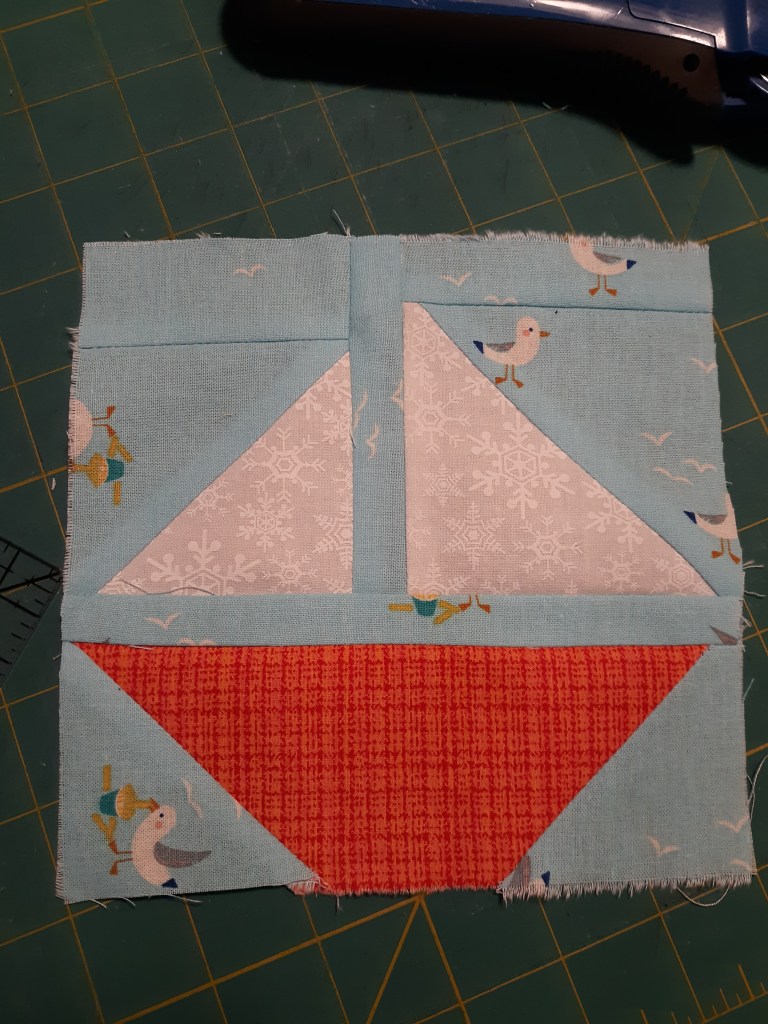
Sometimes we don’t trust the instructions we’re given. It happened to me again just this week. Assembling the quilt block in the attached picture, I followed the instructions, but it just didn’t seem like the pieces could possibly come together to make the sailboat. I laid all the pieces out. I even overlapped them to account for the seams. But it just didn’t seem right. A few of the pieces were just too big. They couldn’t possibly fit together to make a 6 ½” block.

Maybe I cut the triangles the wrong size. That would account for the difference. I recut the triangles ¼” smaller and then sewed the pieces together. They didn’t fit. They were too small. Impossible. I went back to the original measurements given in the instructions, sewed all the little pieces together, and voila, a perfect little sailboat block.

How did they all come together correctly when it looked like they would never work? Someone with much greater knowledge than me had created the pattern, so they knew exactly how big each piece needed to be. I should have trusted the pattern maker.

Back in Exodus, God gave very specific instructions for the tabernacle, and then the temple. And his instructions were followed to the letter. They had to be. He would accept nothing less.

Today there is no tabernacle or temple. But we have something better. God sent Jesus in the flesh to tabernacle (live) with us. After his death, he sent the Holy Spirit to live within us, making our bodies his temple. And he gave us his living Word, full of wisdom and instructions, all we need for life and godliness (2 Peter 1:3).

We can trust the instructions he has given us because they are his design. He knows how it will all turn out, even when we don’t see how it could possibly work. As the creator and sustainer of all there is, his instructions are flawless and produce beauty and glory when followed.

And the best part is we can “read it again!” (out loud if necessary).

Stepping Stones or Crushing Stones

Are you content in your circumstances? If your current circumstance involves smooth sailing and no worries, then you probably are. But you can count on that changing. When we rely on our circumstances for our contentment, we will be disappointed on a regular basis. So, if our circumstances are always changing—sometimes bright and sunny, sometimes dark and gloomy—how can we be content consistently?

Obviously, contentment cannot be founded on things that can change. That would be like building a contentment castle in the sand at low tide. It can’t last. There are tides, an ebb and flow, that will surely wash it away. Tides are something you can count on, twice a day, every day. Contentment must be built on something that never changes. The only thing that never changes is God himself. So, he needs to be our source of contentment.

When we realize that our circumstances are given by God for our good, we can be content in any circumstance. That doesn’t mean we won’t feel sad or angry or confused at times. Having emotions and being content can coexist. Contentment has more to do with trust—trusting God in our circumstances and our emotions. The ladies of our church have been studying contentment. One of them said something brilliant, just off the top of her head. When I say things off the top of my head, they may be  funny or sarcastic but rarely brilliant. So, I told her I would be stealing it. And here it is: our circumstances can either be stepping stones or crushing stones. See, I told you it was brilliant.

Our circumstances should be stepping stones, to move us from one place to another. The circumstance becomes our classroom where we learn something that moves us forward. And each time we allow our circumstance to teach us, we find it easier to be content and trust God even more. But when we focus on the circumstance itself and not on God, it often becomes a crushing stone, our spirits being crushed under its weight until there is no hope.

The apostle Paul was very familiar with difficult circumstances. One of those circumstances was actual stoning, talk about crushing stones! But he allowed his circumstances to be stepping stones, to learn from them and allow them to build in him what was lacking. He tells us in Philippians 4:11b-13 (ESV) “…for I have learned in whatever situation I am to be content. 12 I know how to be brought low, and I know how to abound. In any and every circumstance, I have learned the secret of facing plenty and hunger, abundance and need. 13 I can do all things through him who strengthens me.”

The “secret” Paul learned is contentment. That is how God strengthened him to be able to do all things, including facing and enduring any circumstance, to be content. Will your next difficult circumstance be a stepping stone or a crushing stone? Be content and trust God to strengthen you for your next step.

Photo by Picasso dela Cruz on Pexels.com

The Red Sea and Ocean Blue Cabinets

I was annoyed. When we moved into our new home in January, my goal was to have a kitchen in our in-law suite by mid-summer. Hope swelled when we ordered the cabinets in April with a two-week lead time for delivery. But then we learned they wouldn’t be ready until the end of June. Okay, they’ll be in by the end of summer. Summer was the goal and was still in play.

June came and went with no cabinets. A few more delays. Finally, on August 19, my beautiful ocean-blue cabinets were delivered. My annoyance grew. The water and drain lines weren’t in yet. My cabinets just sat there mocking me. They were there but unusable. Summer was waning. Pumpkin spice everything was on its way as soon as the calendar flipped to September.

So, when September 1 came around and the cabinets were not yet installed, my hopes were crashing. But before the first day of September ended, an uninvited guest arrived at our house, specifically in our in-law suite. Her name was Ida, Hurricane Ida. She didn’t just arrive—she forced her way inside. As our living space filled with water, Doug grabbed some boards from the garage and hoisted the cabinets onto them. We didn’t know when the deluge would stop, but at least it might help to get them off the floor.

For hours, we scooped, shop-vacced, and soaked up water. It never went deeper than two inches, just reaching the very bottoms of the cabinets. They were saved because they hadn’t been installed yet.

This week, I read the story in Exodus 14 of Israel crossing the Red Sea. It stuck out to me that they were passing by it when God said to Moses, “Come back and encamp there, facing the Sea.” Wait a minute. They could have been long gone, but God put them right where he wanted them so they would see how only he could save them. And he did.

Saving my cabinets was not nearly as miraculous. But all the time I spent being annoyed they hadn’t been installed seems pretty silly now—a lot like the Israelites complaints about being brought to the Red Sea to die. God was just setting the stage to show his timing is perfect in every situation, whether it’s saving his people in the midst of the sea or just a few ocean-blue cabinets in the midst of a hurricane. He is completely trustworthy.

“21 Then Moses stretched out his hand over the sea, and the Lord drove the sea back by a strong east wind all night and made the sea dry land, and the waters were divided. 22 And the people of Israel went into the midst of the sea on dry ground, the waters being a wall to them on their right hand and on their left. 31 Israel saw the great power that the Lord used against the Egyptians, so the people feared the Lord, and they believed in the Lord and in his servant Moses.” Exodus 14: 21, 22, 31 ESV