Lessons from a Fire: Lesson 2 – Danger from Within

Lessons from a Fire: Lesson 2 – Danger from Within

Two weeks ago, I shared parallels between a fire destroying a local bank and sexual abuse. The first lesson was about setting up boundaries to start rebuilding from a place of safety. You can read that blog here. The parallels didn’t stop with the boundaries. Today’s lesson is on the danger that no one could see.

The day of the fire, customers and employees came and went without a clue that there was something dangerous going on within the walls of the bank. It wasn’t someone planning a heist or a disgruntled employee about to explode. It was an electrical short, literally within the walls.

This branch looked no different than any other. Everything seemed completely normal, with no cause for alarm. But just hours later, the wailing of alarms pierced the air. Three fire companies raced to the scene. Witnesses described flickering hues of bright orange as flames engulfed the lobby. Thick black smoke billowed skyward. Vinyl siding dripped on the outside, insulation sparked inside, baskets of promotional pens melted into white mounds.

Once the fire was doused, the extent of the damage could be assessed. The building was a total loss. It would have to be torn down and rebuilt. The investigation found that faulty wiring caused the fire. It was an electrical problem that had been festering probably from the time the bank was built several years earlier. It finally got to a point that a spark triggered a fire within the walls, destroying the entire building.

Again, I thought of the devastation of sexual abuse. Abuse victims are among us everywhere we go, yet we can’t tell they are survivors of something so devastating. They look like everybody else in our circle. They smile, they raise their kids, they go to work, they attend church, they cheer for their home teams, they go to the beach for vacation. They seem just like you. Maybe they are you.

But maybe something has been smoldering inside them, unknown to anyone else. That was me. No one knew I had suffered sexual abuse until my abuser was arrested a decade later. People thought I was just a quiet, introverted child. Really, though, fear and shame paralyzed me.

 Survivors can live a lifetime with something smoldering under the surface. Every now and then, they squelch a small fire, and no one ever knows about it. Other survivors barely make it through the day without a complete meltdown. They succumb to triggers that send them into a tailspin of disaster. They try to hide the damage, but eventually that short circuit will shake them to their foundations.

Like the bank, they may need to tear things down to safely rebuild what was lost. There’s a process of removing the damage left by shame, fear, anger, mistrust, and hopelessness. It starts with talking about what happened with someone safe. It takes time to process what happened and how it affected them. But with a strong foundation of safety and support, they can rebuild with confidence.

There’s no point in pretending the abuse didn’t happen or didn’t cause any damage. Imagine if the bank had done that—just continued business as usual, ignoring the damage the fire caused. They probably wouldn’t have stayed in business very long. A support group is a great place to start repairing the damage. Survivors can share their deepest struggles with others who can empathize with them and begin peeling away the layers of damage.

The bank hired a professional to rebuild their building. They had the blueprints and ability to remake the bank building exactly as it was before. Survivors are in even better hands because God is in the business of healing and restoration. Even if there is no support group or counselor around you, God is always with you. You can trust him with all the damage abuse caused. He already knows what’s been going on inside of you that no one else can see. He knows what triggers you, and he knows the plans he has for you. He won’t leave you living in brokenness. He has a plan to build your life into something strong and beautiful.

I will restore to you the years the swarming locust has eaten (or the fire has burned or the abuse has stolen). This promise of God in Joel 2:25 was my foundation as I began the healing process. And God has been faithful to his promises. He walked with me through the fire of abuse. He took away my shame and fear and replaced them with hope. He made me stronger, more compassionate, and more resilient than I would have been without the abuse and the work it took to overcome it. He more than restored the years lost to abuse. And he will do that for all who put their trust in him.

Look for (at least) one more lesson from the fire in another week or two.

Lessons from a Fire – Lesson 1: Safety First!

A fire tore through a local bank building just over a year ago. The lobby was destroyed. Remnants of black smoke clung to the stone facade above the boarded-up doors and windows. Clearly, there was structural damage to the drive-thru, and large pieces of fascia curled away from the building like peeling paint. Over the next few weeks, a salvage company demolished the rest of the building and leveled the ground around it. The burned-out business put up signs saying they were rebuilding. Several months passed with no evidence of rebuilding. But then a construction company’s billboard-sized sign appeared, announcing the rebuilding project was underway.

This time, evidence of rebuilding appeared. Heavy equipment was parked on the property. Dirt was pushed around. But what stood out to me was that barricades were set up. One of the first steps in rebuilding was making the project safe. A big part of that safety plan was to keep out those who might cause more harm.

As an abuse survivor, those barricades were a visual reminder of the need to set up boundaries while in the process of rebuilding what was lost. Many survivors have false guilt when they create space between themselves and those who might cause them harm. They know that some of those people don’t mean to cause harm, but their words or attitudes do just that. So, to rebuild their emotional health, they may need to erect some barricades and keep certain people out of their lives, at least for a time.

The barricades on the bank building remained until the construction was just about completed. They were in place until all the structural work was done, and just the finish work on the inside was left. But it occurred to me that the inside still has a barricade in the form of a vault. Very few people who enter the bank will be allowed access to the vault. It’s not for everyone, just those with the right clearances. Survivors should make note of that too. There will always be parts of their life or story that are not for everyone, just the most trusted people in their lives. And that’s okay. It’s not just okay, it’s necessary.

Most abusers are people who were trusted. Being harmed by someone you trusted is as damaging to a person as that fire was to the bank. Like the rebuilding of the bank, survivors need to do the work of removing the damaged areas and preparing their hearts to rebuild trust. Rebuilding trust takes time.

Start with the barricades. They allow you to rebuild from a place of safety. The first steps might be with a counselor, pastor, or trusted friend. It might be in a support group. It needs to be with people who won’t do more harm. Over time, you will rebuild trust and be able to take down some of the barricades because you’ll feel safe without them. In the process of rebuilding, you’ll become more resilient. Even if someone harmful shows up in your life, it doesn’t mean that what you’ve rebuilt will come crashing down. You will have learned that other people don’t control you or your emotions—a big step in the rebuilding process.

Eventually, you’ll feel that the barricades can come down, except that vault. The keys to that are only for certain individuals and God himself. He is the one who can be fully trusted with your heart and life. We will never fully understand the depth of his love and care for us. He promises he will fight for us, he will restore us, and he will bring us safely home. Even when we don’t feel safe or wonder if all that was lost to abuse can be restored, God will fulfill his promises, and we can rest safely in that.

After you have suffered a little while, the God of all grace, who has called you to his eternal glory in Christ, will himself restore, confirm, strengthen, and establish you. 1 Peter 5:10 ESV.

Daffodil Hope

Early spring in my neck of the woods is one of my favorite seasons. Down by the lake behind our house, the peepers hatched, and they fill the air with unending chirps. The red-wing blackbirds are back, squawking loudly. Their songs are challenged by the grackles’ return and their calls that are reminiscent of an old rusty swing.

There’s a red hue on the tips of the tree branches, promising the gray winter woods will soon be replaced with the pale green of new leaves. Slivers of bright yellow are peeking through buds on forsythia bushes, ready to burst. A few pink cherry blossoms have already popped open. All of these are signs that spring is indeed here.

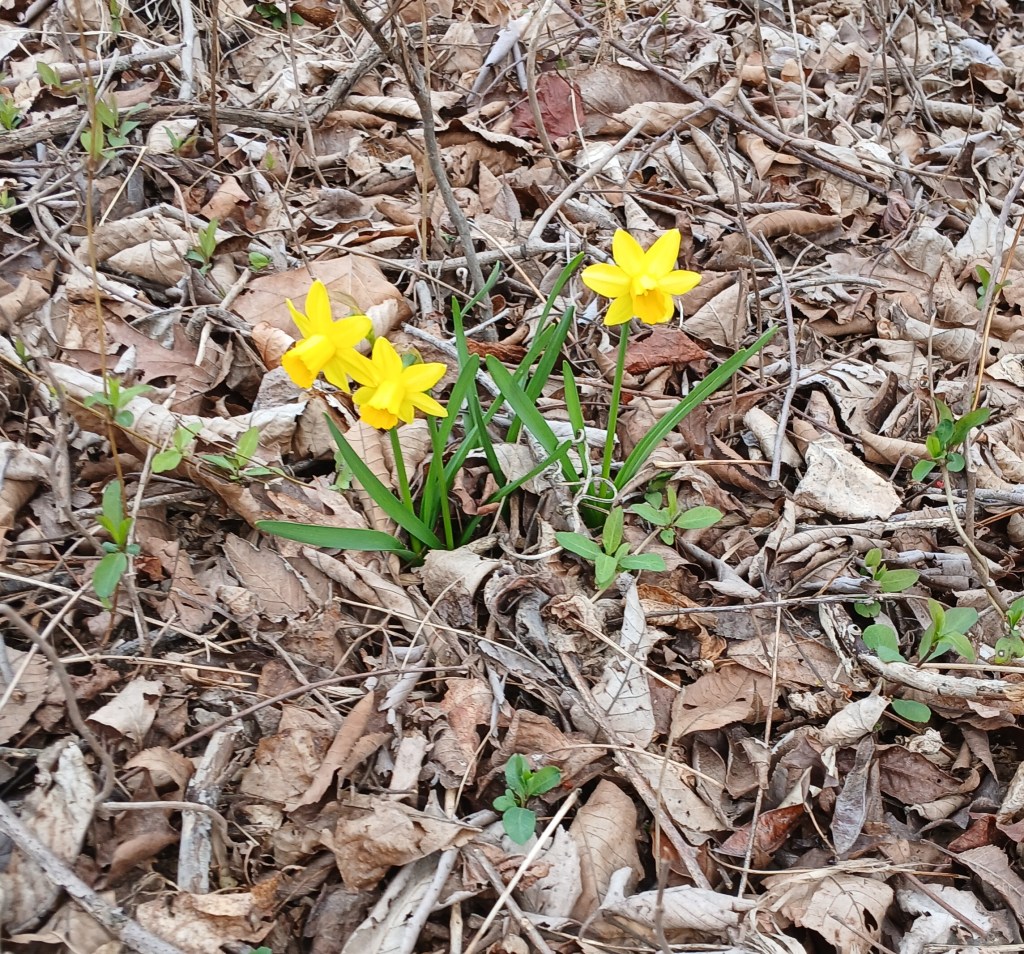
My favorite sign though is the daffodils blooming in the woods. I think it’s because they sprout and bloom among the dead leaves on the forest floor. New life rising from where there was only death. I can walk through the woods, with the dead leaves and fallen branches crunching under my feet and come upon a delicate daffodil with its colorful little trumpet reaching for the light. They brighten my mood, making me smile. They give me hope that more flowers and warmer temperatures are on the way. And they are a perfect picture of new life in Jesus. We were dead in our sins, but God made us alive in Jesus.

Maybe it’s not a perfect picture of new life in Jesus because the daffodils always had some life in them, even as dormant bulbs. They just needed the right conditions to sprout and come to life. We are kind of the opposite really. We are alive: eating, breathing, heart beating. But spiritually, we aren’t dormant, we’re dead. Warm temperatures, a change in seasons, the right amount of rain and sun—none of it will bring us to life. It took another death, the death and resurrection of God’s own Son, for us to have a chance at new life, eternal life.

New life can come at any time of year for those pursuing it, not just springtime. It doesn’t have to wait for the seasons to change. It just takes recognition that you’re dead in your sins and a desire to be alive. Believing that Jesus died in your place so that you can have eternal life is the beginning of faith. Faith blooms and flourishes as it pushes through the dead stuff of our lives, leaving it all behind, and reaches for the light of the world. These are the thoughts I have when I see the first flowers of spring among the deadness of winter’s remnants. And my heart is forever grateful for the new life I was given forty-five years ago.

Why stay dead when Jesus offers you eternal life? Spring is a perfect time for a new life—a season of new beginnings, of hope, when the dead are raised to life, like my little woodland daffodils.

But because of his great love for us, God, who is rich in mercy, made us alive with Christ even when we were dead in transgressions—it is by grace you have been saved. Ephesians 2:4-5 NIV

Monochrome Life

Does your life ever feel monochrome? Gray? Boring, lacking color or vibrancy? That’s what I thought about as I looked out at the scene before me. Gray rocks, gray water, gray sky. The mountain, too, would be gray, if it wasn’t socked in behind the gray fog. A darker gray line delineated the horizon. There is beauty in it if you’re willing to see past the bleakness.

As I sat there looking into the gray water and sky, I thought how this is the way I sometimes see my life. Chronic pain is its monochrome feature. Always there, some days with the heaviness of darker, stormier gray, other times just a little misty gray fog.

Glancing to my left, the late July huckleberry bushes were covered in green huckleberries. More monochrome, only green, making it difficult to distinguish the berries from the leaves. But then I noticed a few of the huckleberries had started to ripen. A lot were green, but some were pink, some were a deep wine, and others were already purple. It won’t be long until they will bring joy to a little girl I know who loves to pick them.

The changing berries gave me renewed hope. Life is not monochrome forever. Even today, I can tell the sun is trying to burn off the fog and gray clouds. A brightness comes and goes bringing hope for a more colorful day ahead. Sometimes it just takes a little time.

My monochrome of chronic pain will have its season. But there will be colorful times interspersed, even during days when the pain is great. There are friendships that bring hot-pink laughter. There are soothing violet pleasures in reading a good book. There are happy, bright yellow squeals from grandchildren. There is the deep blue calm of prayer. The monochrome that tries to take over gets pushed back just a little.

And when the gray lingers, it is a reminder to lean on the one who created the full spectrum of color. He has chosen which colors to use in just the right amount to create his masterpiece. He knows when to blend in other colors and when to just leave the gray. One day, when we look back at the design he has chosen for each of us, we will be amazed at the beauty the grays brought to our lives.

Embrace your monochrome days. They have beauty and purpose and will make the colors around them even more glorious. And just maybe with a little time, they will give way to unexpected vibrant-colored joys.

For I consider the sufferings of this present time are not worth comparing with the glory that is to be revealed to us. Romans 8:17 ESV

The Beauty of Hope

The beauty of spring is all around us. Sometimes Doug and I are amazed that God has provided such a beautiful place for us to live. While driving into town this week, Doug pointed out two routes that are faster than the one I was taking. I know there are faster routes, but the one I take is so pretty—red buds and dogwoods in full bloom, azaleas, tulips, and cherry tree blossoms swirling in the breeze. The natural beauty is complemented by lovely, restored Pennsylvania farmhouses and barns. This route is definitely worth an extra two minutes.

My favorite spot is a pasture encompassed by a split rail fence. It is home to two caramel-colored horses. And today, the pasture was covered with thousands of little yellow buttercups. Beyond the pasture is a picturesque view of the valley. It’s at an intersection, an easy spot to stop for a few extra seconds, taking in the scene. I was thinking I should write a blog on God’s beauty reflected in his creation.

But then, while at my infusion appointment, the doctor told me he doesn’t recommend doing any more infusions. They don’t seem to be making any difference in how I feel. This is my sixth one, and if I don’t feel any better, they probably aren’t going to work. The hope that I felt six weeks ago was lost as the last infusion dripped through the IV.

On my drive home, the same route I took to get there, I didn’t notice any of the beauty I had earlier. Nothing had changed along the way. The trees, flowers, houses, barns, even the horses were still there. But I had lost hope. We see everything differently when we have hope. But when hope is lost, even the beauty around us fades.

I tried to pull myself out of hopelessness. After all, what had really changed? The treatment didn’t work. So what? It didn’t make my condition worse. It just wasn’t going to bring healing. The only thing lost was some time and a boatload of money—but nothing of eternal value. One more thing can be crossed off my list of possible treatments. But I was struggling with this outcome, dwelling on it to the point of missing the beauty all around me.

Then I got a text from a friend who didn’t know what had happened with me today. She sent me a song by Matthew West called Don’t Stop Praying (https://www.youtube.com/watch?v=bpbZqMJ-B44). She didn’t know where I was in my spirit, but God did. He knew, he cared, and he rescued me—the same things he has done for me over and over again. You might even say, he showed me his beauty, which never changes from season to season, regardless of my circumstances.

 It’s okay (maybe even necessary) to grieve what is lost, whether that is people, finances, health, or anything else. God doesn’t expect us to ignore the difficult things in our lives and just move on. But he does comfort and strengthen us through those things, and then he refocuses us on himself. When we turn our attention to him in prayer, our hope is renewed, and his beauty fills our eyes and permeates our spirits.

This door in having my health restored has closed, but I’m going to take Matthew West’s advice: don’t stop praying! And I’ll get to that blog about God’s beauty another day (or did I do it anyway?).

“Rejoice in hope, be patient in tribulation, be constant in prayer” (Romans 12:12 ESV).

New Season, New View

As I sit here, looking out the big, bay window beyond my dining room table, all I see in the distance is a line of trees. A few still have flowers, but most have dropped their petals and turned to the lush, bright green of mid-May. A few weeks ago, sitting in this same spot, I saw a lake in the distance, just beyond my property line. But now, the leaves of the trees have obscured it. If I look hard in just the right place, I can catch a glimpse of water. But if I didn’t know it was there, I probably wouldn’t notice it.

Two scenarios come to mind as I consider this landscape. Both had me contemplating how I handle difficulties. In the first one, I pretend the lake (difficulty) doesn’t exist. Visitors to my home wouldn’t know it is there. It’s invisible to them. They might even call me crazy if I told them there is a lake back there. In this scenario, I welcome the cover of the trees. Deep in my mind and heart, I know it’s out there somewhere, but I don’t need to look at it or even think about it. In this season, it has disappeared.

The fall may start to bring the lake into view again, with small peeks as the leaves drop their cover. By winter, all I’ll see is the lake. The trees covering it up will become bare and gray, blending into the winter sky. When I ignore difficulties or try to cover them up, pretending they aren’t there, they always seem to resurface and even dominate my life for a season.

In scenario two I know the lake is there, even though I can’t see it right now. I am ever on the watch for it. Sometimes I even go down to it and see what’s going on there – people kayaking or fishing, birds swooping up mosquitos (thank you very much), beavers adding to their lodge. The lake has purpose. I welcome the time I can spend there. There’s a quietness not found in other places. I learn new things about the lake and the wildlife that call it home. I share it with friends and grow from the camaraderie of that shared experience. And when the colder, more barren seasons come, it’s no surprise to me that there’s a lake out there.

I plan to walk down to the lake often this summer, checking out how it changes in a new season, and reminding myself that life’s difficulties have purpose. Each one is a chance to see things from a different perspective, to learn and grow in some way. I won’t cover up my problems or hide them behind a cheery smile, pretending they don’t exist. I will share them with my close friends who will help me through them with their prayers and friendship and, no doubt, some laughter.

The lake and trees are all part of a bigger picture. I hope to find joy in all of it. Maybe I’ll even try a little ice fishing when winter comes (no, I won’t).

“…we rejoice in our sufferings, knowing that suffering produces endurance, and endurance produces character, and character produces hope” (Romans 5:3,4 ESV)

Uncertainty

I’ve sat down at my computer several times today to write this blog post. If I had a typewriter, there would be a lot of crumpled pages in and around the trash can. I thought I knew what I wanted to write, but each idea fell short. What would be best for this week? A funny anecdote? A serious reflection? A hopeful exhortation? Nothing felt right. Maybe I should just write what I’m feeling.

We are all going through a strange time in our history. Most of us haven’t experienced anything like this before. I don’t really know what I’m feeling. It isn’t fear. It isn’t worry. It definitely isn’t hopelessness. I think it’s uncertainty. I like having all my ducks in a row, and I don’t know how this pandemic will play out. I’ve read so many contrary opinions from the “experts.” But the truth is, no one knows.

In the last two weeks, three close friends have lost loved ones. Two more are not expected to live through the week (none are virus-related). Their families can’t hold services for them now and can’t have visitors. I’m a hugger. Everything in me wants to hug my friends or at least be by their side. But I can’t get within six feet of them. My only choice is to turn hugs into words, which for me right now, fails to express my love and desire to comfort them.

Today has been especially uncertain. My husband left for work this morning where he will be helping in the ICU instead of his normal job in the OR. It left me feeling a little nervous. Then I got word this afternoon that one of our family members has tested positive for COVID-19. Those feelings of uncertainty mounted. How will these things work out? Sometimes I want God to pull back the curtain and show me the plan, especially the ending. But where would my faith be? It would be in what I can see and not in the God who holds it all together.

In these uncertain times, I need to ask myself, “Do I really trust God for all things?” Usually I can figure out how things are going to go. But these last few years have taught me that life can change on a dime. I have learned to trust God with every little thing so when the big things come, it is second nature. I heard Veirdre Jackson say at a conference recently that she could run in the thin air of the mountains because she trained hard in the valley. The air is feeling thin right now. It’s hard to take a deep breath. But, thankfully, I have had a lot of time training in valleys. I know where my hope lies and who holds the future. If this is more of a training valley for you, take one step at a time and trust God for the next.

“Now faith is the assurance of things hoped for, the conviction of things not seen.” (Hebrews 11:1 ESV)

Not My First Pandemic Rodeo

It occurred to me today that this is not the first time I have been isolated at home due to a world-wide health crisis. In 1977, I got the flu. At that time, it was called the A1 Asian Flu, later called the Russian Flu. It almost exclusively affected young people under age 23. Because of a similar flu outbreak in the 1950s, most adults were immune to it (let that be encouraging to y’all right now). My doctor told me I was the second person in the US to get it and had the worst case. I’ve always had a competitive nature.

I was 13 years old, starting eighth grade, when I got sick in the fall of 1977. I missed about two months of school prior to Christmas break. In January 1978, I was feeling better, except for severe pain in my back. After a hospitalization and more testing, doctors discovered the virus seemed to have eaten away the discs in my thoracic spine. They felt that immobilizing my spine would allow the discs to heal.

In February 1978, I entered the hospital to have a body cast applied. Really, it wasn’t a full body cast, it was a body jacket. It started with a large neck brace, extending down onto my chest and covered with a plaster cast. The cast was applied from my neck to my hips, hence, “body jacket.” A very nice nurse washed me up, spending a good amount of time using warm water to gently remove bits of plaster from parts of my body that didn’t need it. I stayed in the hospital for a week under a heat lamp to dry the plaster. I could bend at the hips, but not well. My arms were free. I could move them but not lift them completely over my head. This made washing my hair tricky, but once at home, I figured out a pretty efficient system using the kitchen sink sprayer.

Since I had already missed so much school time and was supposed to move as little as possible, I went on homebound studies. I could have visitors, but I couldn’t play. In fact, I got in trouble one day when my Spanish teacher arrived and saw me playing catch with my sister. I didn’t think it was a big deal, but everyone else did (except my sister—bless her heart for taking me outside to do something).

I spent most of my days watching soap operas. Because my cast damaged the furniture, there was one chair I was allowed to sit in. Sleeping was tough. The cast would pop up in the front and dig into my back. Of course, I couldn’t shower. And I rarely left the house because people stared. It was not a good time.

May 4, 1978 finally arrived—cast removal day. I was so excited and terrified. Cutting off a cast that is around one’s neck is scary. Once it was off, I felt so free and light, except my head, which seemed to weigh about 50 pounds! My neck muscles had atrophied over four months of no use. I actually had to use my hands to hold my head up. But my time in isolation was over.

I lost a year of school, being with friends, and playing outside—all without internet or cell phone, talk about isolation. We can do this. Hold your heads up, friends. This time of world-wide pandemic and isolation will be over soon.

“But you, O Lord, are a shield about me, my glory, and the one who lifts my head.” Psalm 3:3 NASB