Can’t Get Me!

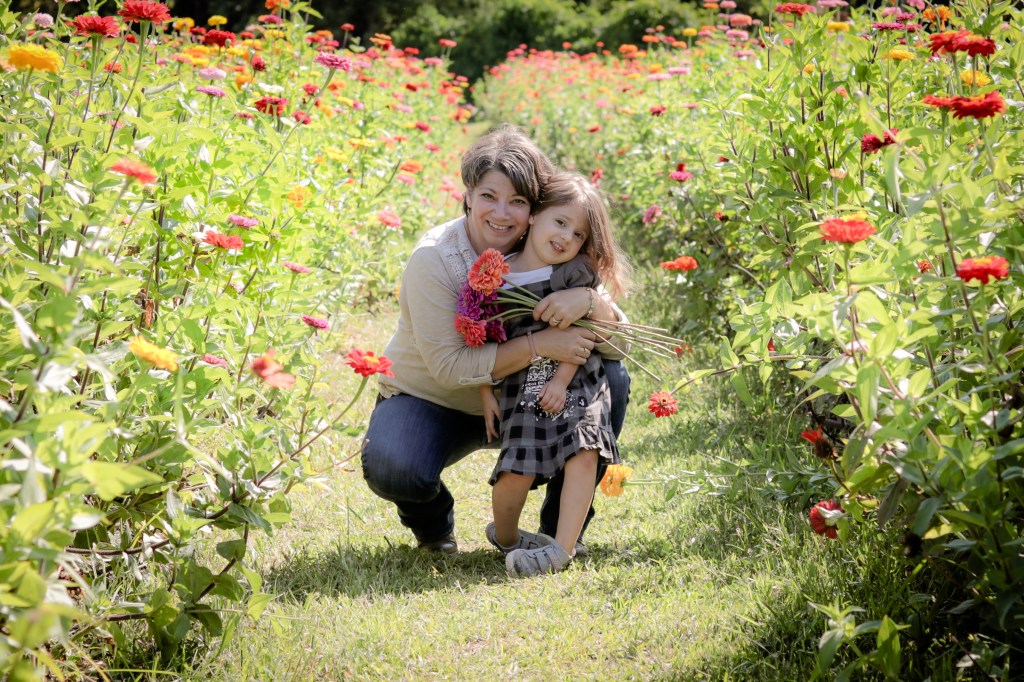
My sister offered to do a photo shoot for my website at a local zinnia farm (four years ago this week). I took my granddaughter Emma along to get some pictures with her too. She loved all the bright flowers and being the center of attention. This photo is one of my favorites of us together. The farm was beautiful and a perfect location for photos.
This farm also had some animals living there. We wandered over to the barn area where we met a rather large sheep. My experiences with sheep have been benign, not like goats. Goats can be traumatic. A goat ate my hat when I was little, and I never forgot. And they always seem to delight in headbutting people. Sheep are usually more docile and easily intimidated. They are more likely to run off or even go stiff and fall over when startled. Not this sheep. Emma walked up to it, and it sized her up. The sheep took a few steps back, then charged, headbutting her in the stomach, knocking her on her butt. I thought she would be terrified, but she just laughed and walked away.
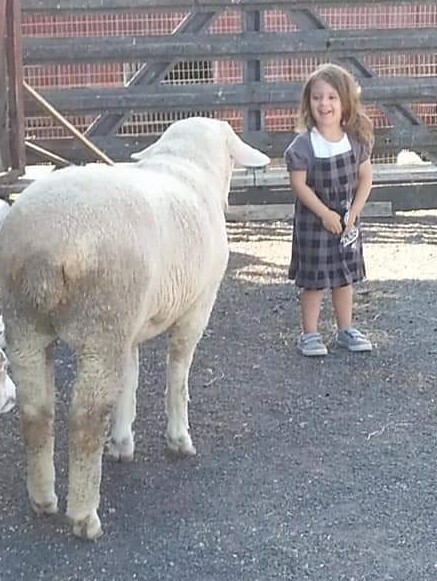
The sheep followed us around the barnyard. At first, we laughed about it. But its menacing presence became a constant threat. It tried several more times to knock Emma down, sneaking up on us from behind. Finally, we decided to move outside the fenced barnyard where the sheep couldn’t get to us. It worked. The sheep was not so scary with the fence between us. Emma even mocked it just a little, her sing-song voice squeaking, “Can’t get me.” We skipped away, hand in hand, with no fear that the sheep was coming after us.

Satan is a lot like that sheep. He tries to knock us down. He wants us to worry about where he is and what he’s doing, constantly looking over our shoulder. He can be menacing, making us run in fear. But, like that sheep, he also is penned in. He doesn’t have freedom to do whatever he wants to. He is limited to what God allows him to do. The Christian need not fear Satan or his schemes.

Sure, there times that he may get to you, causing you some fear or worry. Maybe he even knocks you down temporarily. But remember, He can do nothing outside of God’s control. They are not equals, dueling it out for control of the universe, like Darth Vader and the Jedi. We don’t need to route for God, hoping things go his way. Satan’s future has already been decided. God created him with a purpose, and that purpose has an end date. One little Word will fell him. Jesus has already defeated him. So go ahead and mock him just a little. He can’t get you.

“But the Lord is faithful, and He will strengthen you and protect you from the evil one.” (2 Thessalonians 3:3 NIV) “The God of peace will soon crush Satan under your feet. The grace of our Lord Jesus be with you.” (Romans 16:20 NIV)

Just a Little Off

Rock climbing. It was supposed to be a day conquering the rock faces of High Rocks Park and rappelling back down, my favorite outdoor pastime. But as we rounded the last curve of the narrow, winding road that led to the entrance, we met an oncoming car, driving up the middle of the road. Doug pulled our little Plymouth Arrow truck as far to the edge of the road as he could. Just when we thought we had squeezed safely between the car and the edge, the right front tire slipped off the macadam onto the soft ground. The rest of the truck was still on the road. We were barely moving, but as hard as Doug tried to get the tire back onto the macadam, it was no use. The truck started leaning to the right. We were going over the cliff.

The truck flopped onto the passenger side with a loud bang. The next few seconds seemed to move in slow motion. There was a crunching sound as it rolled onto the roof. With three of us in the cab of the truck, I was unbelted in the middle, sitting on a folded sofa cushion stuffed in between the seats. That’s the way we did it in the early 1980s. I felt myself heading toward the windshield. Doug’s forearm struck me in the chest, slamming me back against the seats, just as the windshield cracked. Jagged lines spread across the windshield, and tiny shards of glass sprayed throughout the cab. The truck continued its downward roll with more popping and cracking. Would the truck stay in one piece at it plummeted to the bottom, ninety feet below? Would we survive?

The driver’s side hit the ground, and the truck came to a sudden stop with a jolting thud, throwing the three of us into a pile. With Doug on the bottom of the pile, he couldn’t help my sister and I push the passenger door open, which was now located above us. Then we heard voices outside the truck, “Are they dead?” The people from the Honda were pulling on the door. We pushed, they pulled, and finally the mangled door gave way. We scrambled out and sat on the side of the truck. The passenger of a passing car gawked at us and remarked, “Heck of a place to park.”

As we oriented ourselves, we realized the truck had only rolled three quarters of a turn. The undercarriage of the truck had come to rest against a tree.  We were about twenty feet below the road. We sat on the side of the truck taking inventory of the damage, to us and the truck. The truck was a total loss, but the three of us just had bumps and bruises (and a few concussions we would later learn). Someone had gone to the park office and reported the accident. We heard galloping. “The cavalry’s coming?” I wondered out loud. Not exactly. It was a medic on a horse. After checking us out and declaring us fit enough to wait for a tow truck, our hero on horseback rode off with my sister squished onto the saddle, arms tightly around his waist. What in the world?

We found where the tire had gotten off the macadam. It was just a three-inch drop. Why hadn’t it been able to get back up? Why did the truck roll over the cliff? I remembered this accident as I read about a Christian leader who has gone off track. I wondered how he had gotten so far from the truth. He had been ministering well for so long, but now, after decades of solid teaching, he was espousing things that were unbiblical. I realized it only takes a small turn off the narrow road before you can fall off a cliff. It was a good reminder that I need to constantly test what I’m hearing, reading, and teaching with the truth of God’s Word to make sure I stay on solid ground.

“You were running well; who hindered you from obeying the truth? This persuasion is not from Him who calls you.” (Galatians 5:7-8 ESV)

Cicada Life

It’s quiet. Very quiet. Considering we live in the middle of nowhere, the quietness shouldn’t seem out of place. But for June and into July, our woods have been home to the emergence of the 17-year Cicadas. Millions of them. For a few weeks we were forced indoors. We couldn’t hear each other speak. Their incessant hum even drowned out the roar of the mower. I could deal with the noise coming from the trees, but then the buggers started leaving the trees. They were not expert flyers. It was like they just stumbled out of the trees and hoped to land on any flat surface. That flat surface was often our heads, arms, legs, whatever they could grab onto with their little spikey feet, scaring the bejeebies out of me.

But now, that has all changed. There are still a few broken-hearted stragglers humming away. But I am afraid they have missed out on love. It’s sad, really. This was their only chance, after 17 years of waiting and preparing. Their red, bulgy eyes must be filled with tears, as their calls for love go unanswered. Their carcasses are lying in the driveway, the patio, the pool, the deck. Their time on earth is very brief—at least the time they spend in sunshine. I suppose, technically, for an insect, 17 years is a long lifespan. But they only live above the ground for a few weeks, just long enough to find a mate and start the process over for the next brood, which will emerge in another 17 years.

Our lives on this earth are so much longer and fuller. I mean, we do more than just procreate, as great as that one aspect of life is. But in view of eternity, our lives here are likewise very short, no more than a speck in time. It’s what we do with this life that matters. By all means, procreate. But maybe try a different tactic than hanging out in a tree, making a lot of noise.  

Concentrating on the eternal just so happens to make our short time here even better. It’s a blessing to love our neighbors, care for one another, help those in need, rejoice always, weep with those who weep, share the Gospel, pray for others, give generously, and love the Lord your God with all your heart, mind, and strength. These are things that will last long after our mortal bodies give out and turn to dust, like the last few cicada carcasses littering my patio. Their life is over, their job done, but ours is just beginning.

You do not even know what will happen tomorrow. What is your life? You are a mist that appears for a little while and then vanishes. (James 4:14 NIV)

Can It Be 20 Years?

“But do not forget this one thing, dear friends: With the Lord a day is like a thousand years, and a thousand years are like a day.” 2 Peter 3:8 NIV

My mom could make us laugh, snorting and all, but she didn’t always mean to. She was mostly deaf and would repeat what she thought we said. Often, what she heard and repeated back, could have landed her a spot on The Tonight Show. The best part was that she would laugh, too.

But it was one phrase that was her legacy. And it wasn’t something she misheard. Although when I repeated it back to her, she laughed like we so often had. Here’s what happened.

I grew up on a quiet street in a small town. Our house was smack dab between my mother’s cousin on one end of the block and an uncle on the other end of the block. Forget the “quiet street” part. There were always family members around. Her cousin, my Auntie Alma, was my favorite relative. She was really nice to me, and I loved everything about her. She was known for talking a lot and laughing more. She was always put together, hair perfectly coiffed, clothes impeccable.

Auntie Alma owned a boutique dress shop on Main Street. I loved it there. It was something I wished I could do, even now. As a twelve-year-old, I thought it was the coolest thing in the world. She “hired” me to help her around the store, washing windows, sweeping the floor, learning the art of making customers happy. Auntie Alma knew her customers. She kept a little box with index cards for each one, marked with what style they liked, their sizes, color preferences, upcoming occasions, etc. When a customer came into the store, she would pull out the dresses she bought “just for them.” Her taste was excellent, and her salesmanship even better. As her customers pulled back the curtain on the fitting room, Auntie Alma would ooh and ahh and have them twirl, then she would accessorize them. By the time they left the store, they had bought several dresses, along with matching purses, scarves, and jewelry. Auntie Alma was the master.

Unfortunately, I didn’t have nearly enough time with her. When I was in high school, Auntie Alma was diagnosed with breast cancer. In only a few weeks, she was gone. We all missed her terribly, and like most families, life events were measured by before or after Auntie Alma died.

One day, driving my mother to the pharmacy, after she was prescribed Thyroid medication, the measuring rod of Auntie Alma’s death was pulled out.

Mom said, “You know, Auntie Alma was on this same medication.”

“No, I didn’t know that.” I answered.

“Yes, she was.” Then came the phrase that has become our family’s tag line for anyone who has died. Mom said, “She would still be on it, if she had lived her whole life.”

I looked at her, thinking she was kidding. Yes, Auntie Alma died in her 50s but…I started laughing.

“What? What did I say?” Mom asked, seriously not knowing what was so funny.

“Mom, when someone dies, they did live their whole life.” Her brain took a few seconds to process that before she burst out laughing. Tears rolled down my face from my squinted-shut eyes. I had to pull the car over until I could see again.

And that’s how it happened. Whenever someone talked about a dead relative, it was followed by “if they had lived their whole life.”

“Nana would have turned 90 this year, if she had lived her whole life.”

“Dad would have bought a party boat, if he had lived his whole life.”

“Uncle Joe would have loved this, if he had lived his whole life.”

You get the idea. I told this story at my mom’s funeral. It got a laugh from most of the mourners, lightening the occasion. But when I said that line, “Auntie Alma would still be on it, if she had lived her whole life,” one of my mother’s cousins leaned over to another cousin and said in all seriousness, “That’s true, she would.” It must be genetic.

New Season, New View

As I sit here, looking out the big, bay window beyond my dining room table, all I see in the distance is a line of trees. A few still have flowers, but most have dropped their petals and turned to the lush, bright green of mid-May. A few weeks ago, sitting in this same spot, I saw a lake in the distance, just beyond my property line. But now, the leaves of the trees have obscured it. If I look hard in just the right place, I can catch a glimpse of water. But if I didn’t know it was there, I probably wouldn’t notice it.

Two scenarios come to mind as I consider this landscape. Both had me contemplating how I handle difficulties. In the first one, I pretend the lake (difficulty) doesn’t exist. Visitors to my home wouldn’t know it is there. It’s invisible to them. They might even call me crazy if I told them there is a lake back there. In this scenario, I welcome the cover of the trees. Deep in my mind and heart, I know it’s out there somewhere, but I don’t need to look at it or even think about it. In this season, it has disappeared.

The fall may start to bring the lake into view again, with small peeks as the leaves drop their cover. By winter, all I’ll see is the lake. The trees covering it up will become bare and gray, blending into the winter sky. When I ignore difficulties or try to cover them up, pretending they aren’t there, they always seem to resurface and even dominate my life for a season.

In scenario two I know the lake is there, even though I can’t see it right now. I am ever on the watch for it. Sometimes I even go down to it and see what’s going on there – people kayaking or fishing, birds swooping up mosquitos (thank you very much), beavers adding to their lodge. The lake has purpose. I welcome the time I can spend there. There’s a quietness not found in other places. I learn new things about the lake and the wildlife that call it home. I share it with friends and grow from the camaraderie of that shared experience. And when the colder, more barren seasons come, it’s no surprise to me that there’s a lake out there.

I plan to walk down to the lake often this summer, checking out how it changes in a new season, and reminding myself that life’s difficulties have purpose. Each one is a chance to see things from a different perspective, to learn and grow in some way. I won’t cover up my problems or hide them behind a cheery smile, pretending they don’t exist. I will share them with my close friends who will help me through them with their prayers and friendship and, no doubt, some laughter.

The lake and trees are all part of a bigger picture. I hope to find joy in all of it. Maybe I’ll even try a little ice fishing when winter comes (no, I won’t).

“…we rejoice in our sufferings, knowing that suffering produces endurance, and endurance produces character, and character produces hope” (Romans 5:3,4 ESV)

Turning Birth Order on Its Head

The Birth Order theory has been around since the late 19th century. Of course, firstborns didn’t need theories and research to tell them they were natural-born leaders, with higher intellect than their siblings. The basic theory is that a child’s personality is formed, in part, by their birth order in the family. The firstborn in a family is bossy, confident, and responsible. Middle children tend to be competitive but peacemakers, adaptable but impatient, and often feel forgotten. The baby of the family is outgoing, charming, and doesn’t take life too seriously. Sound familiar? Are you picturing your siblings—maybe how the baby got away with everything? Me too.

I was the baby: charming, quite adorable, and a natural entertainer. My mom always said, “Someday, you’ll make the stage.” But I often felt more like a middle child: always trying to make peace and please everyone. As time went by, I became a confident leader. Of course, there are negatives associated with the birth order personalities.  

As the adorable baby of the family, my brand of humor was sarcasm. Not everyone thought my sarcasm was as funny as I did. I may still struggle with that from time to time. My middle-child personality was a little overly competitive. Winning was everything. There was no second place in my world. There was winning and losing, and heaven help the teammate who didn’t play to win. I don’t struggle as much in this area anymore. And the firstborn personality’s sense of responsibility resulted in being a rule follower to the letter. For everyone. If you weren’t following the rules, I let you know. Rule following seems to have left my life at the same time as my gall bladder. Who knew they were related? Positive or negative, I didn’t fit into just one of the birth order personalities. Now what?

Lots of things mess with the birth order theory: twins, age differences, blended families. My story makes mincemeat of it. I was the baby in my adoptive family. But recently, I learned that I am the firstborn on my birth-father’s side and a middle child in my birth-mother’s family. Finally, my complicated personality makes sense.

But I have my own twist on the birth order theory. The biggest change in my personality came when I was born again at 16 years old. That’s when the firstborn traits began to appear. My confidence grew as I learned my identity was in Christ as God’s own adopted child. And my middle-child tendencies grew as peace took up residence in my heart. Even the baby in me grew, allowing me to hold loosely to this world and look forward to the future.

I was born to an earthly family and adopted into another earthly family. Then I was born again into a heavenly family and adopted by a heavenly Father. Yes, my birth order is complicated. For the first four months of my life, I had a name, and I lived in foster care. Then I was given a new name, new parents, and a new home. But that’s not where the story ends. When I was born again, I was given a new identity and position in the family of God, an heir with Jesus of the glory to come.

I have met several members of my birth families. It has been exciting to learn about them. Most of them never knew I existed. What a difference from my heavenly Father, who has not just known me but chose me and substituted his own Son to die in my place so that I can live forever with them. As the firstborn, Jesus has gone on to prepare a place for me, and I look forward to the day our Father gives me a new name and welcomes me home for the last time.

“3 Blessed be the God and Father of our Lord Jesus Christ, who has blessed us in Christ with every spiritual blessing in the heavenly places,even as he chose us in him before the foundation of the world, that we should be holy and blameless before him. In love he predestined usfor adoption to himself as sons through Jesus Christ, according to the purpose of his will,” Ephesians 1:3-5 (ESV)

White as Snow or Poop Lasagne (whichever resonates with you)

Yup, we’re talking poop. Those of you who know me well, know that poop talk happens now and then. I mean, I live with a puppy, a newborn, and two toddlers still in diapers. “Who pooped?” is a question heard several times a day. Hang with me, it will be all right.

We have lived in our new house for four weeks. Things are coming together, but one of the things we haven’t exactly figured out is where the dogs ought to poop. During those four weeks, we have had four snowstorms. Because of all the snow, the poop area became right outside the front door. Our puppy has to “empty” while on a leash. That means that somebody, usually me, has to be holding the other end of the leash. So, I stand at the edge of the front walk while the puppy finds a good spot to empty, and that way I don’t have to walk in the snow.

Because snow comes with a lot of coldness, I don’t stay outside long or trek into the snow to pick up the poop right away. Before I knew it, there was a lot of poop. And then it would snow again, covering the darkly contrasting piles. It has become something of a poop lasagne with alternating layers of poop and snow.  Over the last few days, some melting occurred, and lots of poop was exposed. How gross. I decided to scoop up as much as possible since it was trash day and another storm was on the way. Unfortunately, most of the poop was so frozen to the snow/ice underneath, I couldn’t get much of it up. I pried. I pulled. I tried to dig underneath. It wasn’t budging. I gave up, looking at the piles of frozen poop in disgust. But the next day it would all be hidden again under a fresh layer of snow. How convenient. (See attached picture) But at some point, it will all come to the surface and have to be reckoned with.

I looked over the poop lasagne in my front yard and thought what a great picture of sin. Sometimes I get rid of it as soon as it is exposed. But too often I just let it get frozen in place and promise to deal with it later, especially the “lesser” sins like worry, ingratitude, or selfishness. But the longer I let it go, the more solidly embedded in my heart it becomes. The clean-up can be a long, difficult process. Sometimes it takes some serious prying and chipping away. But God’s Word says that He will make my sin as white as snow. It’s not that a pristine layer of snow hides it, like the poop lasagne. Jesus actually removes it as if it had never been there. I can start fresh, clean, like new fallen snow.

“Come now, let us reason together, says the Lord:
though your sins are like scarlet,
    they shall be as white as snow;
though they are red like crimson,
    they shall become like wool.” (Isaiah 1:18 ESV)

Just Put It On

Not again. Thinking through my mental shopping list, I jumped from my car and hustled into the store. The automatic doors whooshed open, and it hit me. I didn’t have my mask on. Again. Darts shot from the eyes of the masked shoppers sanitizing their carts in the entryway.

You would think 10 months into the mask-wearing phenomenon, I would remember it every time. But I don’t. I forget it when I’m hurrying or distracted. I have at least one mask in each car. There’s one in my tote bag. I usually have one in my purse or coat pocket, but not this time. I felt exposed, almost naked. I couldn’t spin around fast enough and get back to my car where my “Merry Christmas” mask would save me from the fearful stares and judging eyes peering over less festive masks.

At first, I didn’t do well with mask-wearing. They triggered my claustrophobia. There were times I needed to step into a deserted aisle to pull the mask down for just a few seconds before a panic attack took over. The paper ones were not good at all. They seemed to stick to my face, and I felt like I couldn’t breathe. Realizing mask-wearing was going to become the norm, I adjusted my homemade design to fit lower under my eyes, making me feel less confined. Then I just needed to remember to put it on before entering a store.

The words I saw on Facebook every day rang in my head, “just wear the mask,” “put on your mask,” “mask up,” “save lives, wear the mask.” It frustrated me. Viruses are microscopic. These cloth masks aren’t going to keep them out. Most of the time, I kept my thoughts of masks giving people a false sense of security to myself. Sometimes, I shared my thoughts and found out just how passionate people are about the mask mandate! One of my reasonings is that I wore the mask, and I still got COVID-19. When I was out in public, I never saw anyone not wearing a mask. People in my area have been careful and compliant. Yet, I got the virus the mask was supposed to protect against.

As I thought again about “just put it on,” I remembered another mandate of things to put on. “Put on then…compassionate hearts, kindness, humility, meekness, and patience…forgiving each other…And above all these, put on love, which binds everything together in perfect harmony.” (Colossians 3:12-14 ESV) Being passionate about putting on these things truly would make a difference in our world.

I decided to meditate on these verses every time I put on my mask. I’m hoping they will work their way into my heart and make me more compassionate, kind, patient, forgiving, and loving. We could all benefit from putting on those things. And maybe, just maybe, it will help me remember to put on my mask before I leave my car.

A Split Second

There’s a split second when you realize you’re about to hit another car. A friend’s accident this week reminded me of the accidents I’ve been involved in and that terrifying moment before impact.

Thirty-five years ago, I was headed home, delighted that my work week was over. In just two days, I would become Mrs. Douglas Radcliff. As I left work, I looked forward to celebrating Doug’s parents’ anniversary and then picking up the tuxedos. The day I had dreamed about was almost here. And then it happened.

As I neared the intersection, there was no need to slow down through the green light. But the oncoming car, who was waiting to turn left, decided not to wait any longer. He started his turn just as I entered the intersection, and that was the moment I knew. He was going to hit me. I closed my eyes. BAM! My initial reaction was to check my face in the mirror. No cuts. Great, the wedding pictures will be fine. Then I took inventory of the rest of my body. My knee was bleeding. That was OK; no one would see my knee under my wedding gown. Everything else seemed to be OK, but pain was creeping into my neck, back, and hip. I was wondering if I would be able to walk down the aisle. A knock on my window jarred me out of my wedding worries. I rolled down the window. A woman said, “I know CPR.”

“Great,” I replied, “I’ll let you know if I stop breathing.”

Sirens grew closer. A police officer and EMT were soon prying my car door open. Miss EMT looked me over and asked a few questions. Then she said, “I’m going to cut off your pantyhose.”

I complained, “But they’re my favorite pair.”

She looked a little confused. “They have a hole and blood on them.”

Some EMTs have no sense of humor. She checked me for head trauma. I’m sure she was thinking it was shock. But I was so relieved that I wasn’t seriously hurt, my sense of humor wasn’t even bruised.

The first ambulance had a backboard that didn’t fit into the contoured seats of my car. The second ambulance had a bendable backboard and a giant EMT who could wield it all by himself. As he secured me to it, I said, “I knew I should have lost some weight before the wedding.” He effortlessly lifted my 110-pounds out of the car and said, “You’re as light as a feather.” It seemed I was.

Once loaded into the ambulance, I stated more than asked, “You’re gonna turn the siren on, right?” Giant EMT looked at me quizzically. I explained, “I don’t expect to ride in an ambulance again, so I’d like to do it with the siren on.” He laughed and told the driver I wouldn’t be happy until the siren was blaring. The driver obliged. Then the question came that would punctuate that day, “What day is today?” I know they were just testing my brain function, but it got old pretty quickly. It was a constant reminder of all I was missing out on, not to mention that I didn’t trust my groomsmen to pick up their tuxes without me. I was sure I’d see jackets that were too tight or pants too short at my wedding. I can be a bit of a control freak. My answer was not the day or the date. My answer was always, “It’s two days before my wedding, and I don’t have time for this.”

Unfortunately, that was not my one and only ride in an ambulance and not my only car accident. It was also not the only time an EMT said to me, “If you hadn’t been wearing your seatbelt, we wouldn’t be having a conversation right now. I’d be calling the coroner.” Some were not as serious. I want to mention that none were my fault. But all had that one thing in common: I knew for a split second that I was going to be hit, and it was going to hurt. One minute I was driving along, happily anticipating the evening’s events, and the next, there was pain and debris, my plans ruined right along with my car.

But by God’s grace, my life has gone on, as will my friend’s this week, without lasting injury. I don’t know why God allows these things—things that seem to just take up my time and create headaches both physically and in working with insurance and finding a new car. But I know He has a purpose in everything. Maybe to teach us what is important. Maybe to help us better understand and minister to someone else. I remember at the time of that accident, I was studying and meditating on giving thanks in everything and having joy in trials. Maybe God was giving me an object lesson. I learn better from hands-on experience.

One thing I do know. If the outcome had been different. If they had called the coroner, that split second of fearful impact would have immediately been followed by the most glorious moment anyone could dream of: being in the presence of Jesus. Plans will be forgotten. Missing out on something won’t enter my mind. I wonder if I’ll know it right away or if it will take a second to sink in. I don’t know. Whether death happens suddenly or if I can see it coming for a long time, the joy of that split second of realization that I am with Jesus will be overwhelming. I look forward to it. But for now, I am content and thankful to remain in this life, preferably siren free.

“Therefore, being always of good courage, and knowing that while we are at home in the body we are absent from the Lord—for we walk by faith, not by sight—but we are of good courage and prefer rather to be absent from the body and to be at home with the Lord. Therefore we also have as our ambition, whether at home or absent, to be pleasing to Him.” (2 Corinthians 5:6-9 NASB)

Carry On

Exploring a construction project behind my Dad’s house one Saturday afternoon was an exciting adventure for a nine-year-old kid. I had never walked through an unfinished building before. It seemed so strange to imagine where walls and furniture would be, and what it would look like when it was done. We got to the end, where a door would open onto a patio, just across from my Dad’s back door. There was about a foot-wide gap between the new building and the existing patio. I knew I could jump it, but just to be sure, I gave a little extra umph to my leap. I more than cleared the crevice but overshot my landing just enough that my knee scraped a cement block sitting on the patio. The sharp edge sliced deeply into my skin. My dad whisked me into the kitchen through the back door where my stepmother shook her head and said, “That’s a six stitcher.” She was right.

What I remember most from that day was my dad carrying me. He had picked me up off the patio and carried me into the house. Then he carried me to the car and drove me to the hospital. He lifted me out of the car and carried me into the emergency room, where he never left my side as a doctor sewed my knee back together with six stitches. What I don’t remember is anything he said. He was a quiet man, so maybe he didn’t say anything. But if he did, I don’t remember it. I remember the feeling of being held tightly and carried by him. Sometimes when I’m feeling especially low or vulnerable, I recall that feeling.

Years later, as a teenager in the 70s, my room was adorned with inspirational posters. My favorite was “Footprints in the Sand” by an unknown author—I would love to take credit for its prose. It is summarized like this: we walk through life alongside Jesus, but in our most difficult times, he carries us. I have found that to be true. There are so many crevices to jump, mountains to climb, raging waters to traverse, sand to slog through. The dangers and obstacles can seem insurmountable. But then I remember that feeling of being carried.

A few years ago, I participated in what I’ve come to call “that stupid Spartan race.” If you are unfamiliar, it’s an endurance/obstacle race for the more hardcore athletes among us. I am not one of them. I do enjoy exercise and challenging myself to a degree, and I find ziplining and rock climbing a lot of fun. But I do not find any enjoyment in carrying a 5-gallon bucket of rocks up a mountain. And crawling under barbed wire should be left to boot camp trainees. What I did like about the Spartan race were the spartans. They helped each other. If someone was having trouble getting over a wall, another spartan offered them a hand. Sometimes they connected themselves to become living bridges or steps or whatever was needed to get their fellow spartan to the finish line.

I think that is how Jesus sometimes carries us. He uses the hands and feet he has here on earth, each of us helping the other when the strain of this life becomes too great. We lean into him, and he carries us. Sometimes it is through the peace only he can give. But sometimes it is through the loving arms of his body, the church (individually and corporately), helping each other over the obstacles and around the pitfalls and finally across the finish line, even if they have to carry us.